Dec 14, 2010

Unmanned Boeing UAV in First Flight

Boeing Phantom Ray image courtesy of Boeing
A hi-tech unmanned surveillance craft for military research has taken to the air for the first time, but not under its own power.

On 13 December, 2010, the Boeing Phantom Ray UAV was transported on the back of NASA’s modified Boeing 747 SCA (Shuttle Carrier Aircraft) and this in itself was historic, since no other aircraft apart from the Space Shuttle had previously been carried in this way. Beyond this, though, the flight paved the way for the Phantom Ray’s own flight, set to take place in coming weeks.
UAV designs in present-day US military service include the MQ-9 Reaper, produced by General Dynamics. Boeing’s own UAV portfolio features six designs, from the comparatively low-cost ScanEagle (approximately $100,000 apiece), up to the A160T Hummingbird, which costs upwards of $10m.

Boeing UAV First Flight

The new Boeing UAV’s first flight will occur at Edwards Air Force Base in California – the home of USAF aircraft experimental technology research programmes – and it will follow extensive taxi trials.
“This is exciting not just because it's the first time that an aircraft other than the space shuttle has flown on the SCA, but also because it puts Phantom Ray that much closer to making its first flight”, Boeing’s Phantom Ray program manager, Craig Brown, stated in a company press release issued online.

Phantom Ray UAV

The Phantom Ray UAV was unveiled by Boeing in May 2010. A highly-developed design, work on it has been taking place for two years. According to Boeing, the Phantom Ray will carry out traditional UAV work – intelligence, surveillance and reconnaissance – but it will also be used in combat, and could even gain an air-to-air-refueling capability, too.
The Phantom Ray won’t itself enter US military service, but will be used to take UAV technologies to a new level of advancement. It spans 50 feet across and is set to reach speeds of just below Mach 1, and altitudes of 40,000 feet.
The Boeing 747 SCA has been in use for over three decades. Compared to the standard 747 commercial airliner, the SCA has a reinforced fuselage, stabilizers added to the tail area for improved flight control and a stripped-out cabin.


Dec 13, 2010

Shooting experts eye multi-gun training

By Tony Lombardo - Staff writer
Posted : Monday Dec 13, 2010

MARINE CORPS BASE QUANTICO, Va. — A Marine’s rifle jams during combat. Rather than waste precious time, he throws it down, pulling out the pistol from his drop holster. When that’s out of ammo, he scans the ground, picks up an AK47 from a slain Taliban, and uses that to fire on the enemy.
This combat scenario is not far-fetched. It could happen to you. But are you ready for it?
Experts from Weapons Training Battalion at Marine Corps Base Quantico believe a new trend in shooting competition, termed multi-gun, could be key to better prepping Marines for combat. The battalion is looking to push this training far and wide across the Corps, to a base near you.


Dec 11, 2010

Test of Futuristic Railgun A Success: U.S. Navy

WASHINGTON - The U.S. Navy announced a successful test Dec. 10 of an electromagnetic cannon capable of firing a projectile 110 nautical miles at five times the speed of sound.
"This demonstration moves us one day closer to getting this advanced capability to sea," said Rear Adm. Nevin Carr, chief of naval research.
Tested at the Navy's Dahlgren Surface Warfare Center, Va., the futuristic weapon uses powerful jolts of electric current to propel a non-explosive slug along rails before launching it at supersonic velocities.
The latest test involved a 33-megajoule shot, the most powerful ever attempted and three times that of the previous test in January 2008.
A megajoule is equivalent to the energy released when a one-ton vehicle slams into a wall at 100 miles per hour.
"Today's railgun test demonstrates the tactical relevance of this technology, which could one day complement traditional surface ship combat systems," Carr said.
"The 33-megajoule shot means the Navy can fire projectiles at least 110 nautical miles, placing sailors and Marines at a safe standoff distance and out of harm's way."
He added that "the high velocities achievable are tactically relevant for air and missile defense."
The test model bears little resemblance to a gun. Instead, thick black cables plug into the rear of what looks like a long rectangular grill.
That armature holds the rails together as a powerful electric current surges through them, pushing the slug forward.


Next Generation Arms X7

Whether you are an armed citizen or service professional in the field, with the solid assurance of the military-grade MP168 SPC carbine format AR-15 in your hands, you know you can focus on the goal. In the frigid arctic, the searing desert, the raging sea, jungles, forests, swamps or anywhere else you find yourself, you can be confident in your weapon. The Next Generation Arms MP168 SPC is the extreme environment rifle, and it is unparalleled in its accuracy, performance and dependability in all situations.

Next Generation Arms utilizes the direct gas impingement system, taking advantage of all its benefits and effectively removing the sole disadvantage - fouling. Our Advanced Ceramic Technology (ACT) creates a micro-smooth surface, strongly bound to the moving and bearing parts, that prevents carbon and particle buildup. ACT, together with expert craftsmanship and the highest quality components available, yields a level of reliability never before achieved in the AR-15 platform.
ACT was originally developed by Nathan Roads, the company founder, to prevent the rusting he observed on Coast Guard weapons. As he searched for coatings and treatments that would accomplish this, eventually he tried various ceramic coatings. Although there were numerous problems with the early processes he experimented with, there was evidence that ceramic was much more than just a cosmetic protectant. For example, he noticed the prototypes ran much cooler to the touch and were much easier to clean. After several years of development, all of the hurdles of ceramic surface treatment were overcome and the performance results were very promising, convincing him to forge ahead with Next Generation Arms and the introduction of an AR-15 with a unique advantage.
Nathan began to apply variations of ACT to every interior and interior metal surface in the AR-15 with just a few exceptions, the most important being the chamber itself. A primary requirement for the chamber is to tightly lock the expanded case during firing, however an ACT-coated chamber is too "non-stick" and the case puts dangerous backward force on the bolt face.
Today, after 7 years of continuous development, the MP168 SPC needs no oil in normal operation, needs far less cleaning than typical AR's, runs noticeably cooler and even seems to be more accurate than without treatment. Next Generation Arms is the only rifle manufacturer offering internal ceramic coated actions, barrels and trigger components in completely weatherproof rifles. Our ACT has been extensively torture tested and, although the ultimate wear-out lifetime is not yet known, many of our rifles have been pushed well past the life expectancy of military M16's, with no sign of problem.
Reduced maintenance is a huge benefit to all users. Professional and frequent shooters appreciate that our guns have been tested failure-free past 10,000 rounds without cleaning or other maintenance. Occasional shooters will appreciate that they may never need to clean this rifle. Please note that we do recommend that you maintain your weapon in good working order, which includes a quick (5-10 minute) cleaning after use.
The total ACT system implemented by Next Generation Arms is an expensive process, but we believe it provides advantages that no other maker can achieve, paving the way toward the ultimately reliable MP168 SPC. 
Several customers have reported 3/8 minutes of angle (MOA) accuracy at 100 yards and provided photos or verification by witness. That's 3/8's of an inch scatter in a 5-round group. We guarantee that the rifle can achieve 5/8 MOA at 100 yards with match grade ammunition and bullet weights in the range of 55-77 grains. We and our customers have routinely and consistently hit small targets at all ranges out to 1000 yards, in some cases even with strong cross-wind. The 77-grain match grade hollow point is especially potent beyond 600 yards. It is important to remember that this accuracy and range are accomplished with a military-grade carbine length format equivalent to the M4 and not a special purpose, long barrel gun.
It is fun to watch someone shoot the MP168 for the first time. An inevitable, usually excited comment is "This is the smoothest gun I've ever fired." Muzzle movement and recoil are miniscule. Triggering is smooth, 4lb single stage, with crisp break and quick reset, allowing effortless, safe multi-tapping. Experts are unanimously reporting improved rapid-fire accuracy, with upwards of 30% reduction in various multi-target drills. 


Dec 9, 2010

EMALS hopes for first shot before Christmas

The first launch of an aircraft by the U.S. Navy’s new Electro-Magnetic Aircraft Launch System could take place by mid-December, an event that would mark a major step ahead for a program with its full share of critics and doubters.

“The shot should take place within a couple of weeks,” said Rob Koon, a spokesman for Naval Air Systems Command (NAVAIR). Asked if the engineers were trying to make the launch before Christmas, Koon replied, “that’s what they’re hoping for.”
The Electro-magnetic Aircraft Launch System (EMALS) is a critical piece of technology that will be installed in the new Gerald R. Ford-class aircraft carriers, the first of which is now under construction. If the system isn’t ready in time, the Navy would have to revert to older steam catapults to launch aircraft from the ships, a move that would mean costly delays and redesigns.
An F/A-18E Super Hornet strike fighter is now being instrumented for the launch, Koon said. Test data is being analyzed for safety issues to obtain the necessary flight clearances.
The launch will take place at NAVAIR’s facility at the Naval Air Engineering Station Lakehurst, N.J., where the service and prime contractor General Atomics have built a full-scale test site replicating a shipboard installation, including major software and hardware components.
The development team began shooting test “dead-loads” from the system in the spring, Koon said. Since then, 722 dead-load launches have been made at speeds of up to 180 knots, the highest end-speed requirement for the system. The launch tests are part of the program’s system functional demonstration phase.
If the Super Hornet launch is successful, other types of carrier aircraft will be tested next year, including C-2 carrier-on-board-delivery planes and T-45 Goshawk jet trainers.
Koon said the EMALS program remains on track to deliver its first components to the new aircraft carrier in 2011.
The EMALS system would be the first new launch system since the Navy replaced hydraulic catapults with steam-powered systems in the 1950s. An electro-magnetic system has numerous advantages over steam. EMALS, which involves energizing a series of electro-magnets, is less stressful on aircraft and can launch a wider range of aircraft. The new system also would, theoretically, need less maintenance and cost less to operate.
The efficacy of the EMALS technology and particularly its test program has long been a question for the Navy, Congress and industry. The program — like nearly all technology development programs — has had its share of setbacks, but the service and General Atomics continue to insist the new system will be ready in time for installation on the Gerald R. Ford.
General Atomics made something of a statement of confidence on July 13, when it agreed to a $676.2 million fixed-price contract to produce the EMALS system and a new advanced arresting gear installation for the carrier.
But nothing will quiet critics like the launch of a front-line jet fighter.

The Electromagnetic Aircraft Launch System at Naval Air Systems Command, Lakehurst, N.J.
EMALS motor, HCT-1
From Steam to Magnets: EMALS vs. Current Approach.
Current steam catapults use about 615 kg/ 1,350 pounds of steam for each aircraft launch, which is usually delivered by piping it from the nuclear reactor. Now add the required hydraulics and oils, the water required to brake the catapult, and associated pumps, motors, and control systems. The result is a large, heavy, maintenance-intensive system that operates without feedback control; and its sudden shocks shorten airframe lifespans for carrier-based aircraft.
To date, it has been the only option available. Hence its use on all full-size carriers.
EMALS (Electro-Magnetic Aircraft Launch System) uses an approach analogous to an electro-magnetic rail gun, in order to accelerate the shuttle that holds the aircraft. That approach provides a smoother launch, while offering up to 30% more launch energy potential to cope with heavier fighters. It also has far lower space and maintenance requirements, because it dispenses with most of the steam catapult’s piping, pumps, motors, control systems, etc. Ancillary benefits include the ability to embed diagnostic systems, for ease of maintenance with fewer personnel on board.
EMALS’ problem is that it has become a potential bottleneck to the USA’s new carrier class. It opportunity is that it may become the savior of Britain’s new carrier class.
The challenge is scaling a relatively new technology to handle the required weights and power. EMALS motor generator weighs over 80,000 pounds, and is 13.5 feet long, almost 11 feet wide and almost 7 feet tall. It’s designed to deliver up to 60 megajoules of electricity, and 60 megawatts at its peak. In the 3 seconds it takes to launch a Navy aircraft, that amount of power could handle 12,000 homes. This motor generator is part of a suite of equipment called the Energy Storage Subsystem, which includes the motor generator, the generator control tower and the stored energy exciter power supply. The new Gerald R. Ford Class carriers will require 12 of each.
Because it’s such a big change, it’s a critical technology if the US Navy wishes to deliver its new carrier class on-time and on-budget, and fulfill the CVN-21 program’s cost-saving promises. If EMALS cannot deliver on time, or perform as advertised, the extensive redesign and additional costs involved in adding steam catapult equipment throughout the ship could easily rise to hundreds of millions of dollars.
The related Advanced Arresting Gear (AAG) sub-program will replace the current Mk 7 hydraulic system used to provide the carriers’ built-in system of arresting wires for carrier landings with the requisite combination of plane-slowing firmness and necessary flexibility. The winning AAG design replaces the mechanical hydraulic ram with rotary engines using proven energy-absorbing water turbines coupled to a large induction motor, providing fine control of the arresting forces. AAG is intended to allow successful landings with heavier aircraft, reduce manning and maintenance, and add capabilities like self-diagnosis and maintenance alerts. It will eventually be fitted to all existing Nimitz class aircraft carriers, as well as the new Gerald R. Ford class.
CVF concept
(click to view full)
EMALS may even prove critical to the future of the British CVF Queen Elizabeth Class, if the F-35B fighter proves unable to take off and land with full air-to-air armament. That’s a matter of some concern in Britain, which is looking into alternative landing approaches and sees the F-35C as its primary “Plan B” for naval aviation.
An F-35C would require catapults, however, and their new carrier’s CODAG (COmbined Diesel And Gas) propulsion doesn’t produce steam as a byproduct the way nuclear-powered carriers do. That threatens a significant redesign, and an accompanying rise in cost that could sink the program entirely. EMALS, on the other hand, would leverage the Queen Elizabeth Class’ design decision to become an all-electric ship, and require far less rework to install.
HMS Queen Elizabeth’s expected delivery date is now 2014-2015, and so the question is the same for Britain as it is for the USA: could a working, tested EMALS system be delivered in time?

Corps looks to field 100,000 new packs

By Dan Lamothe - Staff writer
Posted : Wednesday Dec 8, 2010

The Marine Corps is moving forward with a plan to field at least 100,000 new packs beginning in 2012, replacing the existing Individual Load Bearing Equipment system that Marines have humped since 2004.
Marine Corps Systems Command, out of Quantico, Va., is evaluating potential ILBE replacements, and will call the next system the USMC Pack, officials said. The Corps recently accepted proposals from industry and wants 108,000 delivered within the first year of a contract award, with additional purchases likely.


Railgun moves closer to real use

Navy shooting for new world record with test of railgun prototype.

For now, the power of what may prove to be the Navy's most formidable weapon is confined to a research and development lab at the Dahlgren base in King George County.
On Friday, the Naval Surface Warfare Center Dahlgren Division and BAE Systems will take another step in an ongoing quest to put electromagnetic railguns on ships in the fleet.
About 1 p.m., Navy brass, civilian engineers, contractors and reporters will watch a video feed of a projectile--traveling five times the speed of sound--smashing into a steel box filled with sand.
Until recently, a railgun has been a fantasy weapon for video gamers, the stuff of science fiction.
But the technology has been slowly moving toward reality.
The railgun works by a pulse of electricity traveling along two parallel rails to propel a projectile at tremendous speed.
Friday's shot, expected to use 32 megajoules of electromagnetic energy, is by far the most powerful to date. It will take only a fraction of a second, as long as the blink of an eye. It is expected to establish a new world record in the annals of electromagnetic acceleration.
The goal is to show the tactical relevance of the technology, the Navy said in a press release.
"The importance of the 32-megajoule demonstration is the feasibility of the system at an energy level that has military significance," said Roger Ellis, electromagnetic railgun program manager for the Office of Naval Research.
A megajoule is a measurement of energy associated with an object traveling at a certain speed. For example, a vehicle weighing a ton, moving at 100 mph, equals a megajoule of energy.
The Navy would like to have a fully functional 64-megajoule system aboard a ship by 2025.
A shot of that power could reach a target 100 nautical miles away in a matter of minutes. The projectile would travel so fast that no warhead is needed; kinetic energy is sufficient to destroy its target.
Another advantage is that it is safer for sailors because it uses no explosives.
There are formidable technological challenges. The gun requires huge amounts of electrical power and must be scaled down to fit on ships.
The first test shot was in 2006. Then, in January 2008, a prototype at Dahlgren achieved a shot of 10.6 megajoules, a record.
BAE Systems, a national defense contractor with an office in Stafford County, was awarded a $21 million contract last year to develop the railgun prototype.
NSWC Dahlgren Division is the largest tenant command of the Naval Support Facility Dahlgren.


Dec 6, 2010

Made by Ammo

ShotShell Stainless Steel Shotglass

The MadeByAmmo ShotShell will be the last shot glass that you will ever need, period. And we don't say that lightly. Machined from a solid bar of stainless steel, this shotgun shell inspired shotglass will never rust or break. You'll feel like a badass taking a shot of your favorite beverage from a ShotShell.
All ShotShell shotglasses are made in the U.S.A. using premium-grade stainless steel and are 100% dishwasher safe. Each ShotShell weighs nearly a quarter of a pound (4.3 ounces, 122 grams) and holds exactly one standard shot, or 1.5 fluid ounces (44 ml). Product has a bright, machined finish with textured knurling at the base for easy gripping when wet.   
The ShotShell stainless steel shot glass makes a great gift for friends and family (and of course for yourself). Each ShotShell comes in its own soft fabric pouch for storage or for giving away as a gift without having to worry about gift wrapping.

 Product Details:

Machined from Solid Stainless Steel round bar
Extremely Heavy Duty - Will Not Break!
100% Dishwasher Safe
Weight: 4.3 oz. (122 g)
Capacity: 1.5 fl. oz. (44 ml)
Overall Size: 3" tall x 1.4" diameter (at base)
Made in the USA
Laser etched logo
Includes soft fabric pouch


Bullet Bottle Opener Stainless Steel 

The MadeByAmmo Bullet Bottle Opener is one killer bottle opener.  Manufactured from a solid piece of machined stainless steel, it is designed to easily pop off the cap on your favorite beverage.  For those that want to carry around this symbol of manliness, it has a hole sized perfect for your keychain ring.
All MadeByAmmo Bullet bottle openers are made in the U.S.A. using premium-grade stainless steel.  The Bullet makes a great gift for friends and family (and of course for yourself). Each Bullet comes in its own soft fabric pouch for storage or for giving away as a gift without having to worry about gift wrapping.

Product Details:

Machined from Solid Stainless Steel round bar
Extremely Heavy Duty
Weight: 2.7 oz. (77 g)
Overall Size: 2.9" tall x 0.5" diameter (at base)
Made in the USA
Includes soft fabric pouch


Infantry automatic rifle is Afghan-bound

By Dan Lamothe - Staff writer
Posted : Sunday Dec 5, 2010
Five units will soon deploy with the new M27 infantry automatic rifle, a 5.56mm weapon that may one day replace the M249 squad automatic weapon. A total of 458 rifles will be delivered by the gun’s maker, Heckler and Koch, and meted out to five battalions working up for deployments to Afghanistan.

They are:

• 1st Battalion, 9th Marines, out of Camp Lejeune, N.C.
• 2nd Battalion, 4th Marines, out of Camp Pendleton, Calif.
• 1st Battalion, 3rd Marines, out of Marine Corps Base Hawaii.
• 1st Light Armored Reconnaissance Battalion, out of Pendleton.
• And 1st Battalion, 25th Marines, a Reserve unit out of Fort Devens, Mass.

Marine Corps Base Hawaii, 1st Battalion, 3rd Marine Regiment armorers perform a function check on new M27 Infantry Automatic Rifles under the supervision of a Marine Corps Systems Command New Equipment Trainer last Friday. The 1/3 Marines will train and deploy with the weapons to provide feedback that will help decide the weapon systems future in the Marine Corps.
This M27 Infantry Automatic Rifle, along with 83 others, was delivered last Friday to Marine Corps Base Hawaii, 1st Battalion, 3rd Marine Regiment armorers. Since then, M27 IAR gunners and armorers have received training on operating and maintaining the weapon system from Marine Corps Systems Command and gun makers Heckler and Koch.

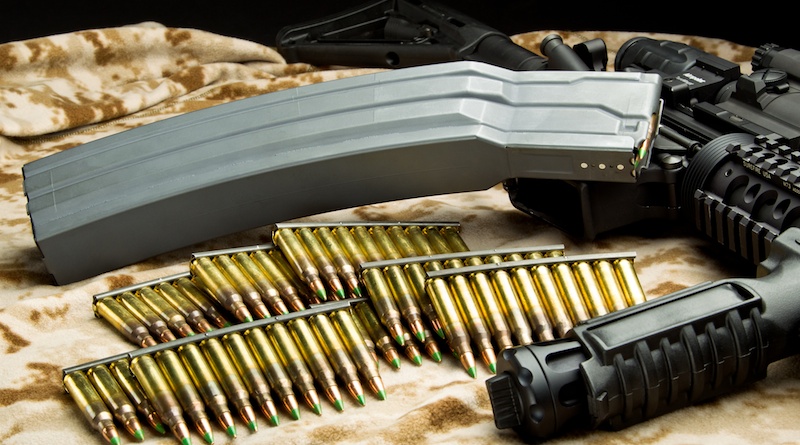
Surefire Hi Capacity magazines

Surefire just broke cover on their high capacity magazine project this weekend. They plan to show the magazines at SHOT Show 2011. Their entry into the magazine market comes in two flavors, 60 and 100 rounds. The MAG5-100, $179, looks a bit unwieldy but the MAG5-60, $129, looks a lot less intimidating.
Derek McDonald, Surefire’s VP of Marketing, who called them “anti-ambush mags” because of the uninterrupted firepower they can provide during the critical, first 30 seconds of an ambush. He said, and later wrote in a press release, that “it takes the average soldier about 4 seconds to reload their weapon and reacquire a target. So, based on the rate of fire of a full-auto rifle, using 30-round magazines means a soldier can fire 150 rounds max in 30 seconds. But, with our 60-round mag he can fire 240 rounds in 30 seconds. And, 100-round magazine means about 300 rounds in the same time.”
The numbers are rough, but the conclusion is airtight. Over the course of a firefight, the time spent changing mags adds up. Bigger mags mean more time on target. This isn’t the first time we’ve heard this premise applied to selling bigger capacity magazines, though. The Beta-Mag people made the same pitch, but the C-Mag was not reliable enough for battlefield use. Surefire’s approach does appear a lot simpler than the C-Mag.
The mags are both made from spot welded, Mil-A-8625 Type III, Class I finished, 6000 series aluminum and have nylon followers.


From Surefire:
“In the current wars in Iraq and Afghanistan, a soldier’s ability to respond to an attack with overwhelming force is critical. Ambushes are commonplace and the outcome of the ambush is often determined in the first 30 seconds.
Firepower and the ability to stay in the fight are key. SureFire’s High Capacity Magazines are designed to provide the war fighter with 60 or 100 rounds of ammunition in a single magazine, thereby decreasing the number of reloads a soldier must perform and increasing the number of rounds available to a soldier to engage threat targets.”
Q.   Do I have to download my magazine to seat it in the weapon with the bolt closed?
A.  No. SureFire HCMs will fit into the host weapon with the bolt closed when loaded with the maximum round count.  The design of the magazine takes into account the allowable tolerances of cartridges manufactured to NATO  and SAAMI specifications.
Q.    Will my 60 round magazine fit into my nylon gear for 30 round magazines?
A.   The SureFire MAG5-60 will fit into most nylon pouches with Velcro cover flaps intended for two 30 round magazines.   Double magazine pouches with stitched partitions may require alteration.
Q.   Will SureFire be offering nylon pouches for these magazines?
A.   Yes. Product specifics and pricing is still to be determined.
Q.    Can SureFire HCM’s be disassembled for cleaning?
A.    Yes, the SureFire HCMs can be disassembled for periodic cleaning or as required.  A punch, the tip of a cartridge or common tool can be used to remove the floor plate from the magazine body.
Q.   What dealers will have access to HCM’s?
A.   Authorized SureFire dealers in states with no high capacity regulations. Rules and processes are being developed for dealers located in states with regulations (CA, HI, IL, MD, MA, NY, OH, DC).


Related Posts with Thumbnails